Han Bennink: The Versatile Virtuoso of Jazz
A Dutch drummer, percussionist, visual artist, and free improvisation pioneer known for Instant Composers Pool, Misha Mengelberg, Peter Brötzmann, and inventive soundmaking.
Originally published on RealBookSoftware.com
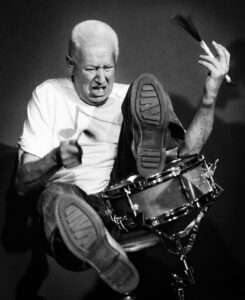
Early Life and Education
Han Bennink, a renowned Dutch drummer and percussionist, was born on April 17, 1942, in Zaandam, near Amsterdam. His first percussion instrument was a kitchen chair, a testament to his innovative approach to music from an early age. His father, a professional orchestra percussionist, later provided him with a more conventional drum set, but Bennink never lost his affinity for creating sounds from unconventional objects.
Career Beginnings
In the 1960s, Bennink quickly gained recognition as an extraordinarily versatile drummer in the Netherlands. He played with several American jazz stars touring the country, including Sonny Rollins, Ben Webster, Wes Montgomery, Johnny Griffin, Eric Dolphy, and Dexter Gordon. He was present on Dolphy’s recording, “Last Date” (1964), and with Gordon on the 1969 album “Live at Amsterdam Paradiso”.
Emergence in European Free Improvisation
Simultaneously, Bennink was instrumental in the development of a European improvised music scene that began to establish its own identity, distinct from its jazz roots. In 1967, he co-founded the Instant Composers Pool with pianist Misha Mengelberg and saxophonist Willem Breuker, which sponsored Dutch avant-garde performances.
Longstanding Collaborations
Bennink is perhaps best known for his long-term partnerships with pianist Misha Mengelberg and saxophonist Peter Brötzmann. He also had a longstanding trio with saxophonist Peter Brötzmann and Belgian pianist Fred Van Hove, which became a duo after Van Hove’s departure in 1976. From the late 1980s through the early 2000s, Bennink collaborated closely with Dutch post-punk band The Ex.
Solo Work and Diverse Instrumentation
In addition to his work with these groups, Bennink has performed and recorded solo, with “Tempo Comodo” (1982) being among his solo recordings. His recordings have occasionally featured him playing other instruments, including soprano saxophone, bass clarinet, trombone, violin, banjo, and piano.
Legacy and Influence
Bennink’s influence extends beyond his music. He attended art school in the 1960s and is a successful visual artist, often constructing sculptures from found objects, including broken drum heads and sticks. He has designed the covers for many LPs and CDs on which he appears. Bennink’s unique blend of musical talent, artistic creativity, and humor continues to inspire and entertain audiences worldwide.
Selected Recordings
- “Live at Amsterdam Paradiso” (1969) – This album features Bennink with the legendary saxophonist Dexter Gordon. It’s a testament to Bennink’s ability to hold his own with some of the greatest names in jazz.
- “Last Date” (1964) – This recording with Eric Dolphy is particularly significant as it was Dolphy’s final tour and recordings before his untimely passing.
- “Han Bennink + Derek Bailey” (1969) – This avant-garde jazz album showcases Bennink’s innovative approach to percussion and his ability to create compelling music with unconventional objects.
- “Han Bennink + Misha Mengelberg” (1971) – This album highlights the musical synergy between Bennink and his longtime collaborator, pianist Misha Mengelberg.
- “Solo” (1970): This is one of Bennink’s solo albums, showcasing his unique approach to percussion and his ability to create a wide range of sounds and rhythms.
- “Nerve Beats” (1973): Another solo album by Bennink, “Nerve Beats” is a testament to his innovative drumming techniques and his ability to push the boundaries of jazz percussion.
- “Solo – West/East” (1979): This album features Bennink’s solo performances in both the Western and Eastern styles, demonstrating his versatility and his ability to blend different musical traditions.
- “Tempo Comodo” (1982): In this album, Bennink explores different tempos and rhythms, creating a dynamic and engaging listening experience.
- “Instant Composers Pool” (1967): Bennink co-founded the Instant Composers Pool with Misha Mengelberg and Willem Breuker. This group sponsored Dutch avant-garde performances and was instrumental in the development of European free improvisation.
- “ICP 30 Year Jubileum, 1997: Day 1”: This album celebrates the 30th anniversary of the Instant Composers Pool. It features performances by the ICP Orchestra, which Bennink was a part of.
- “Clusone 3” (1990s): Bennink was part of this trio, along with saxophonist/clarinetist Michael Moore and cellist Ernst Reijseger. Their performances were a blend of jazz, classical, and folk music.
- “Instant” (1995): This album features Bennink’s collaboration with the Dutch post-punk band The Ex. It showcases a fusion of jazz and punk music.
- “Duo with Misha Mengelberg”: Bennink had a long-standing partnership with pianist Misha Mengelberg. Their duos are a testament to their musical chemistry and shared vision for free improvisation.
Master This Style
Deepen your practice with the professional tools used by jazz masters.
Related Reading in Jazz Abroad
Abdullah Ibrahim: A Musical Journey from Cape Town to Global Jazz Icon
A South African pianist and composer whose music carries Cape Town, exile, resistance, and global jazz into one unmistakable voice.
Acker Bilk: The Clarinet Virtuoso and His Timeless Melodies
The English clarinetist whose breathy sound and "Stranger on the Shore" became instantly recognizable around the world.
Ade Monsbourgh: The Jazz Maestro
An Australian traditional jazz multi-instrumentalist, composer, and bandleader remembered as "Lazy Ade" and "Father Ade."